
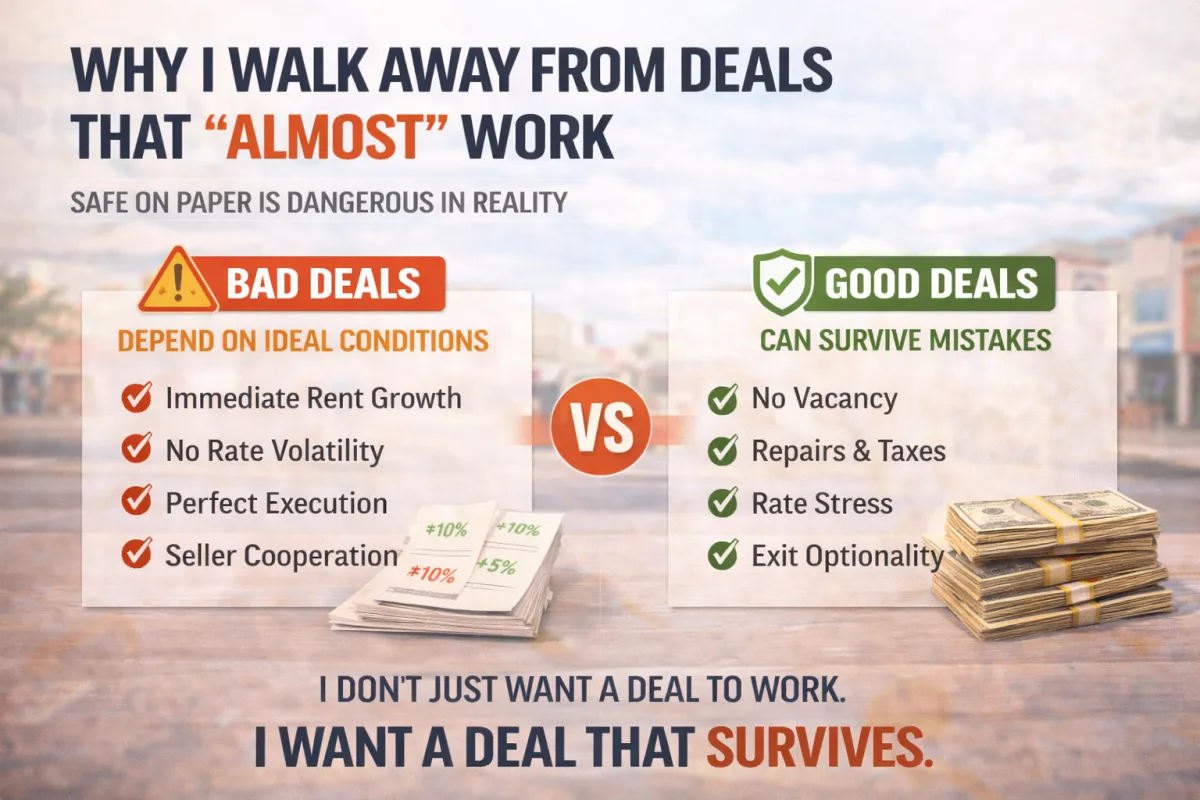
Why I Walk Away From Deals That “Almost” Work
Why I Walk Away From Deals That “Almost” Work
Most bad deals don’t look bad.
They look close.
They pencil if:
Rents grow immediately
Rates cooperate
Execution is perfect
Nothing unexpected happens
Those are the deals I walk away from.
Not because they can’t work —
but because they only work under ideal conditions.
Good deals work conservatively.
Great deals survive mistakes.
Let me show you what I mean using a real deal I reviewed recently.
The “Almost” Deal: Mixed-Use Property in Greenville, SC
This was a mixed-use asset:
Small commercial tenant (tire shop)
Two residential units
Total purchase price: $600,000
On paper, it looked workable.
Not exciting.
Not obviously broken.
Just… tight.
The In-Place Numbers
Gross rents: ~$3,820/month
True NOI after real taxes, insurance, repairs: ~$2,058/month
Property taxes alone were over $15,000/year before appeal
This immediately told me one thing:
The NOI ceiling was low.
Low ceilings change everything.
Where the Deal “Almost” Worked
With standard financing, the deal failed immediately.
So the structure shifted to creative financing:
50% DSCR loan
Seller carry absorbing the remaining balance
Seller carry required to be:
0% interest
No monthly payments
Balloon in the future
Under that exact structure:
DSCR payment ≈ NOI
Cash flow ≈ breakeven
Deal technically “worked”
That’s the danger zone.
Because now the deal required everything to go right.
The Hidden Fragility
Here’s what had to happen for the deal to survive:
No vacancy
No major repairs
No insurance increases
No rate volatility at refi
Seller remaining cooperative long-term
And the biggest risk:
👉 The deal only worked because seller payments were deferred.
That’s not solving the problem.
That’s postponing it.
Why I Don’t Chase “Almost” Deals
This deal didn’t fail because it was stupid.
It failed because it was fragile.
If:
Cash flow disappears with a small expense
DSCR collapses with a minor rate change
The exit only works after perfect rent growth
You’re not buying an asset.
You’re buying a story.
And future lenders don’t underwrite stories.
They underwrite:
In-place NOI
Proven margins
Durable cash flow
The Difference Between Risk and Fragility
Risk is unavoidable.
Fragility is optional.
A risky deal:
Has margin
Has time
Has multiple exits
A fragile deal:
Has one path
Requires precision
Punishes small mistakes
The White Horse Rd deal didn’t fail because it was mixed-use.
It failed because:
NOI had no cushion
Structure absorbed all margin
Exit depended on future cooperation
That’s an “almost” deal.
I pass on those every time.
The Standard I Use Instead
Before I move forward, I want to know:
Does this deal survive flat rents?
Does it survive higher insurance?
Does it survive rate stress?
Does it survive execution mistakes?
If the answer is no — I don’t negotiate harder.
I walk.
Final Thought
Most investors don’t lose money on bad deals.
They lose money on deals that were almost good.
If your deal:
Needs rate relief
Requires immediate NOI growth
Breaks under small stress
It’s not conservative.
It’s optimistic.
And optimism is not a risk strategy.
Want Help Pressure-Testing Your Deal?
This is exactly the work I do with clients.
If you have a deal that:
“Almost” works
Needs creative structure
Depends on a refinance or seller cooperation
I help you:
Stress-test the capital stack
Engineer real exits
Decide whether to fix it or kill it
You can see how I work here:
👉 https://chadchoquette.com/how-i-work
Or review my deal structuring services here:
👉 https://chadchoquette.com/deal-structure-services
Walking away from the wrong deal is a skill.
I can help you build it.
