
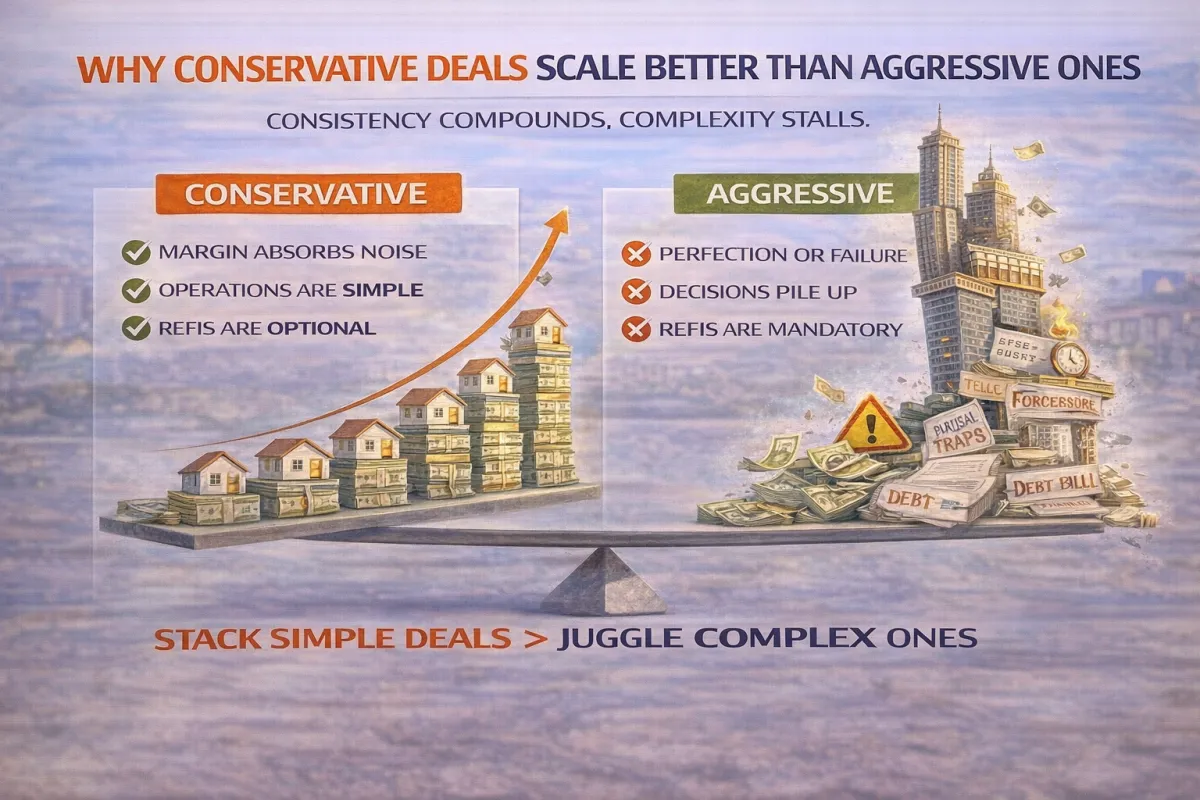
Why Conservative Deals Scale Better Than Aggressive Ones
Why Conservative Deals Scale Better Than Aggressive Ones
Aggressive deals look impressive on spreadsheets.
Conservative deals build portfolios.
Over time, I’ve learned that the deals that scale cleanly are rarely the ones with the highest projected IRR, the most creative leverage, or the flashiest upside story.
They’re the ones that:
Work with margin on day one
Survive bad assumptions
Require less ongoing attention
Leave room for error
Aggressive deals demand constant management.
Conservative deals compound quietly.
Let me show you what I mean using a real deal.
The Deal That Scales: A Small Mobile Home Park With Margin
One of the most scalable deals I’ve worked on recently is a 5-lot tenant-owned-home (TOH) mobile home park in Greenville, South Carolina.
Nothing sexy.
No viral upside story.
No “creative miracle.”
Just math that works.
Deal Snapshot (Simplified)
Purchase Price: $300,000
Gross Rent: ~$4,325/month
NOI: ~$39,900/year
Senior Debt: ~$210,000 @ ~10.75%
Seller Carry: $60,000 @ 0%, no payments for 24 months
Buyer Equity: ~$30,000
Even at double-digit interest rates, the deal produced:
~$1,300/month cash flow
~1.67× DSCR
Zero rent increases assumed
No immediate CapEx pressure
This is what conservative looks like.
Why This Deal Scales (Even at High Rates)
1. Margin Absorbs Noise
This deal doesn’t break if:
Insurance increases
One tenant leaves
Rates stay high longer
Repairs spike
Aggressive deals require perfection.
Conservative deals tolerate reality.
Margin is what allows you to own multiple assets at once without burning out.
2. Simple Operations Reduce Cognitive Load
Tenant-owned-home parks have:
Low maintenance
Predictable expenses
Fewer operational surprises
Compare that to:
Mixed-use assets
Heavy value-add rehabs
Deferred-maintenance hospitality
Retail with business-dependent NOI
Those deals can work — but they consume attention.
Attention is a finite resource.
Scaling requires conserving it.
3. Conservative Deals Don’t Force Refis
Aggressive deals usually need:
Rate compression
Perfect NOI growth
Cooperative lenders
Precise timing
This deal doesn’t.
If rates stay high:
It still cash flows
The seller carry gives runway
No forced refi event exists
That flexibility is what allows you to stack deals instead of juggling emergencies.
The Hidden Cost of Aggressive Deals
Aggressive deals don’t just increase financial risk.
They increase:
Decision fatigue
Capital traps
Time spent renegotiating debt
Exposure to one bad assumption
One aggressive deal can stall your entire portfolio.
Five conservative deals can run quietly in the background while you look for the next one.
That’s how real scale happens.
Why I Choose Compounding Over Impressing
I’m not optimizing for:
Social media excitement
Maximum leverage
Spreadsheet heroics
I’m optimizing for:
Durability
Optionality
Capital recycling
Sanity
Conservative deals don’t demand attention.
They create capacity.
Capacity is what lets you:
Do more deals
Say no faster
Structure better
Walk away when math weakens
The Real Scaling Question
Before you take on your next deal, ask:
“Does this deal get easier or harder to own as I add more deals?”
If the answer is harder — it’s aggressive.
If the answer is easier — it’s conservative.
Only one of those scales.
How I Help Investors Engineer Conservative Scale (Soft CTA)
Most investors don’t need more deals.
They need better structure.
When I work with clients, we focus on:
Entry math that survives stress
Capital stacks that don’t force refis
Seller financing that creates time, not pressure
Exit paths that preserve optionality
If you’re buying deals that look good individually but feel heavy collectively, that’s usually a structure problem, not a market problem.
You can learn how I approach deals here:
👉 https://chadchoquette.com/how-i-work
And if you want help stress-testing or restructuring a deal before it becomes attention-hungry, you can see my deal structure services here:
👉 https://chadchoquette.com/deal-structure-services
Conservative deals don’t shout.
They compound.
That’s the game I’m playing.
