
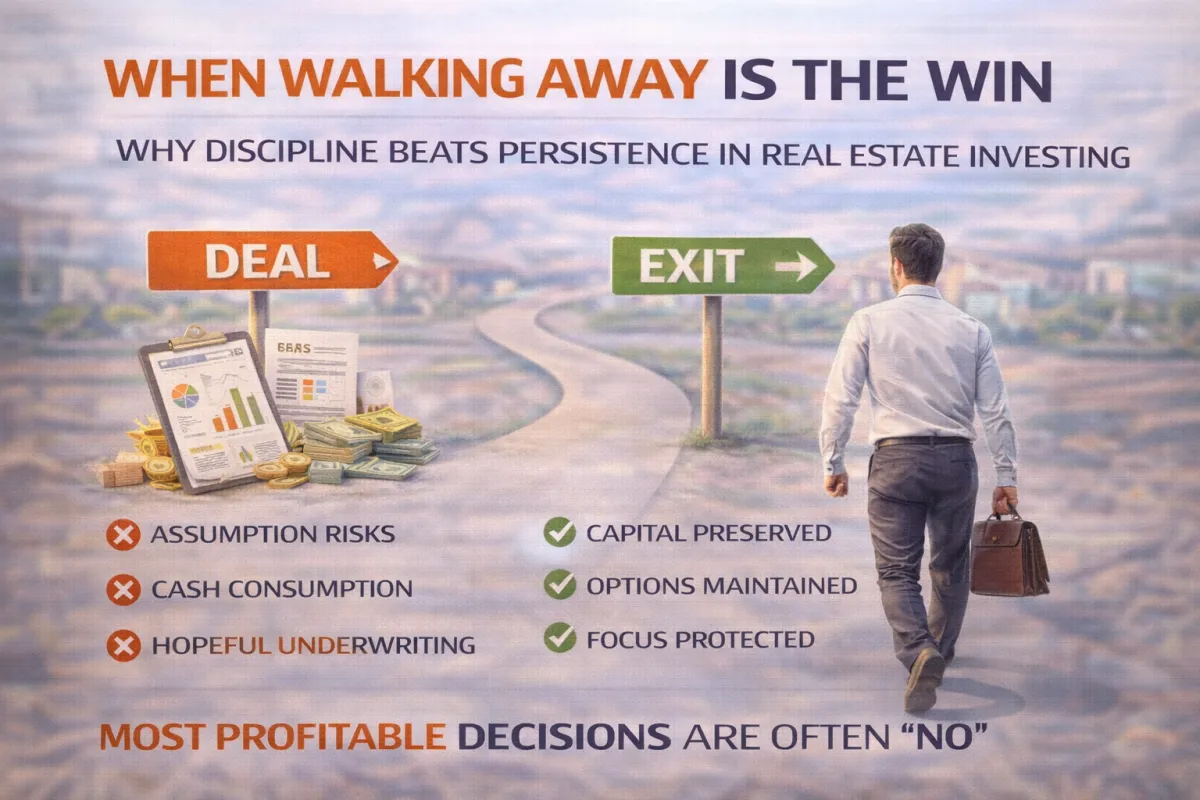
When Walking Away Is the Win
When Walking Away Is the Win
Why Discipline Beats Persistence in Real Estate Investing
Most investors think the win is closing the deal.
In reality, some of the most profitable decisions I’ve ever made came from not closing.
Walking away doesn’t feel like winning — especially after you’ve spent time underwriting, reviewing financials, hopping on calls, and imagining the upside. But sunk cost bias is one of the most expensive traps in real estate.
Bad deals don’t usually announce themselves loudly.
They whisper: “You’ve already come this far.”
This article breaks down why walking away is often the highest-return decision you can make, using a real deal I fully underwrote — and ultimately killed — despite significant time and effort invested.
The Psychology That Destroys Returns: Sunk Cost Bias
Sunk cost bias happens when past effort influences future decisions — even when the numbers no longer work.
In real estate, it sounds like:
“We’ve already spent weeks on this.”
“The seller’s counting on us.”
“We can fix it after closing.”
“We’ll make it work.”
That’s not discipline.
That’s emotional accounting.
Markets don’t care how much time you’ve spent.
Lenders don’t care how hard you worked.
Returns don’t reward persistence — they reward correct decisions.
The Deal That Looked Busy — But Was Broken
North Side Marina & RV Resort — Chico, TX
This was a marina + RV resort deal that initially looked compelling on the surface.
Here’s what the structure required before we even talked upside:
$800,000 seller cash requirement
$300,000 wholesaler fee
~$470,000 assumable SBA loan @ 3.75%
Total cash at close: ~$1.1M
Total implied basis: ~$1.57M–$1.6M
At that point, the question wasn’t “Is there upside?”
It was:
Does the existing business even support this basis?
What the Real Financials Said (Not the Deck)
2024 Actuals (Full Year)
Total Income: ~$462K
Operating Expenses: ~$394K
NOI: –$56,993
True Net Income: –$90,807
This wasn’t a “value-add” problem.
This was a losing business.
2025 YTD (Jan–Sept)
NOI improving, but still modest
Run-rate NOI projected at $45K–$55K/year
Even at a 10% cap, that supports a value of roughly $450K–$550K — not a $1.6M basis.
The Moment Most Investors Make the Wrong Call
This is where deals usually die — or investors double down.
The common rationalizations:
“The assumable SBA loan is cheap.”
“We’ll fix payroll.”
“The restaurant can be optimized.”
“Expansion upside will save it.”
But here’s the truth:
Assumptions don’t erase negative NOI.
And worse — this deal required:
Massive upfront cash
No margin for error
Operational turnaround before safety
A wholesaler fee that consumed real equity
That’s not investing.
That’s hoping.
Why Walking Away Was the Only Winning Move
We walked.
Even after:
Full underwriting
P&L reconciliation
Time spent modeling turnaround scenarios
Conversations with stakeholders
Why?
Because:
The cash requirement was unsupported
The downside was immediate
The upside was speculative
The structure rewarded everyone except the buyer
Walking away preserved:
Capital
Focus
Optionality
Credibility with future lenders and partners
That’s a win.
Discipline Is a Skill — Not a Personality Trait
Good investors don’t close more deals.
They:
Kill bad ones faster
Protect downside relentlessly
Refuse to underwrite “future perfection”
Treat walking away as a decision, not a failure
If a deal:
Requires massive upfront cash
Depends on operational miracles
Justifies price with future fixes
Punishes hesitation
…it’s not “almost working.”
It’s broken.
Where Structure Changes the Answer (And Where It Doesn’t)
Some deals can be saved with better structure:
Seller financing
Deferred payments
Hybrid control structures
Phased acquisitions
Others cannot.
Part of my work is knowing the difference.
That’s why I focus less on “getting deals done” and more on engineering survivable capital stacks.
How I Help Investors Avoid These Mistakes
Most bad deals don’t fail because of price.
They fail because:
Structure is misunderstood
Risk is misallocated
Exit assumptions are untested
If you’re evaluating a deal that almost works, I help investors:
Rebuild the capital stack from scratch
Stress-test refi and exit paths
Identify hidden failure points early
Decide whether to restructure — or walk
You can see how I work here:
👉 https://chadchoquette.com/how-i-work
And review my deal structuring services here:
👉 https://chadchoquette.com/deal-structure-services
Sometimes the most profitable move isn’t buying.
It’s not losing.
