
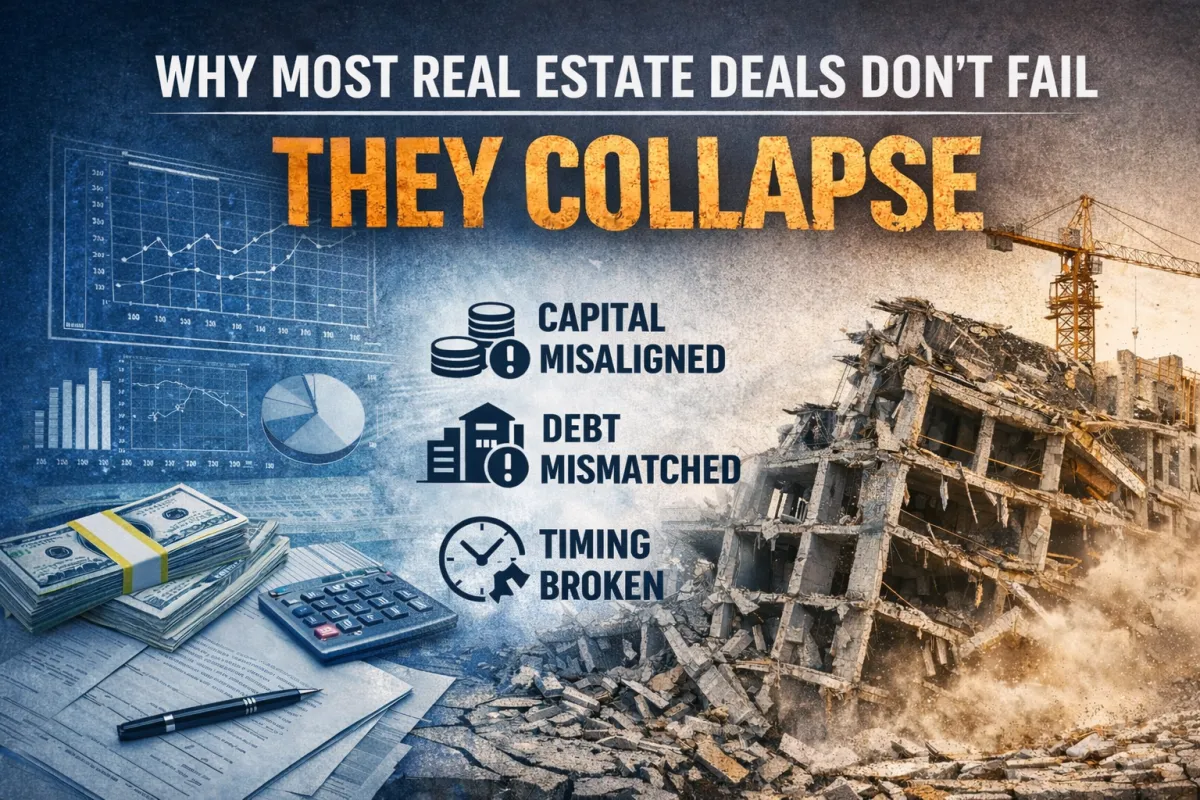
Why Most Real Estate Deals Don’t Fail — They Collapse
Why Most Real Estate Deals Don’t Fail — They Collapse
Most real estate deals don’t fail because they’re bad deals.
They fail because no one engineered them to survive capital, debt, and time.
That distinction matters more than most people realize.
When people talk about deal failure, they usually point to the obvious things:
the market shifted
rates moved
costs came in high
leasing was slower than expected
Those are visible problems.
But they are rarely the root problem.
Most deals are already structurally compromised long before any of that happens.
The Difference Between a Deal and a Structure
A deal is an idea:
a site
a plan
a projected outcome
A structure is what allows that idea to exist in the real world.
Structure is:
how capital enters and exits
how debt behaves under stress
how timelines interact with cash flow
how risk is absorbed instead of transferred
Many deals look reasonable when evaluated as ideas.
They fall apart when evaluated as systems.
This is where traditional underwriting quietly stops short.
Why “Good” Deals Still Break
On paper, many failing deals look fine:
basis isn’t outrageous
rents are defensible
location makes sense
demand is real
But paper doesn’t pay interest.
Once you introduce reality, new forces show up:
interest accrues daily
construction schedules slip
draw timing matters
lenders enforce covenants
equity behaves differently under stress
If the deal wasn’t engineered to handle those forces, it doesn’t degrade gracefully — it collapses.
Not all at once.
Usually quietly.
Usually invisibly.
Until it’s too late to fix.
Capital, Debt, and Time Are Not Independent Variables
One of the most common mistakes in deal evaluation is treating capital, debt, and time as separate inputs.
They aren’t.
They interact continuously.
Change one, and the others move:
Extend the timeline → interest carry increases
Increase leverage → cash flow tolerance shrinks
Delay stabilization → refinance risk grows
If a deal only works when all three behave perfectly, it isn’t resilient — it’s fragile.
And fragile deals don’t fail fast.
They bleed.
Why This Isn’t a Market Problem
When deals fail, people often say:
“The market changed.”
Sometimes that’s true.
More often, the market simply exposed a structure that was already too tight.
Strong structures can survive weak markets.
Weak structures fail even in strong markets.
Markets test deals.
They don’t usually break them on their own.
Underwriting vs. Engineering
Underwriting asks:
Does this work if assumptions hold?
Engineering asks:
What happens when they don’t?
Underwriting focuses on outcomes.
Engineering focuses on survival.
This isn’t pessimism.
It’s realism.
Engineering doesn’t assume failure — it plans for imperfection.
Where Most Deals Actually Die
Most deals don’t die at acquisition.
They die in the middle:
during construction
during lease-up
during the refinance window
during the first real stress event
This is where the structure either:
absorbs pressure
or transfers it to the weakest link
If that weakest link is capital, the deal unravels.
Why Capital Alone Can’t Save a Deal
Throwing more money at a structurally weak deal rarely fixes it.
Capital can:
delay failure
hide timing issues
soften early pain
But it doesn’t correct sequencing errors.
It doesn’t fix mismatched risk.
It doesn’t change math.
Eventually, capital runs out — and structure is exposed.
What It Means to Engineer for Reality
Engineering a deal for reality means:
designing the capital stack before telling the story
planning for timing mismatches, not hoping they don’t happen
building buffers where pressure will occur
acknowledging where the deal is fragile — and deciding if that fragility is acceptable
This isn’t about eliminating risk.
It’s about containing it.
The Quiet Advantage of Structure-First Thinking
Structure-first deals don’t look exciting early.
They:
move slower
say no more often
pass on “almost works” opportunities
But they survive.
And survival is the prerequisite for everything else:
returns
refinances
scale
repeatability
There is no upside without durability.
Final Thought
Most failed deals weren’t bad ideas.
They were ideas that were never engineered to live in the real world.
When capital, debt, and time are treated as constraints — not hopes — deals stop collapsing and start behaving like systems.
That’s the difference between a deal that looks good
and a deal that lasts.
