
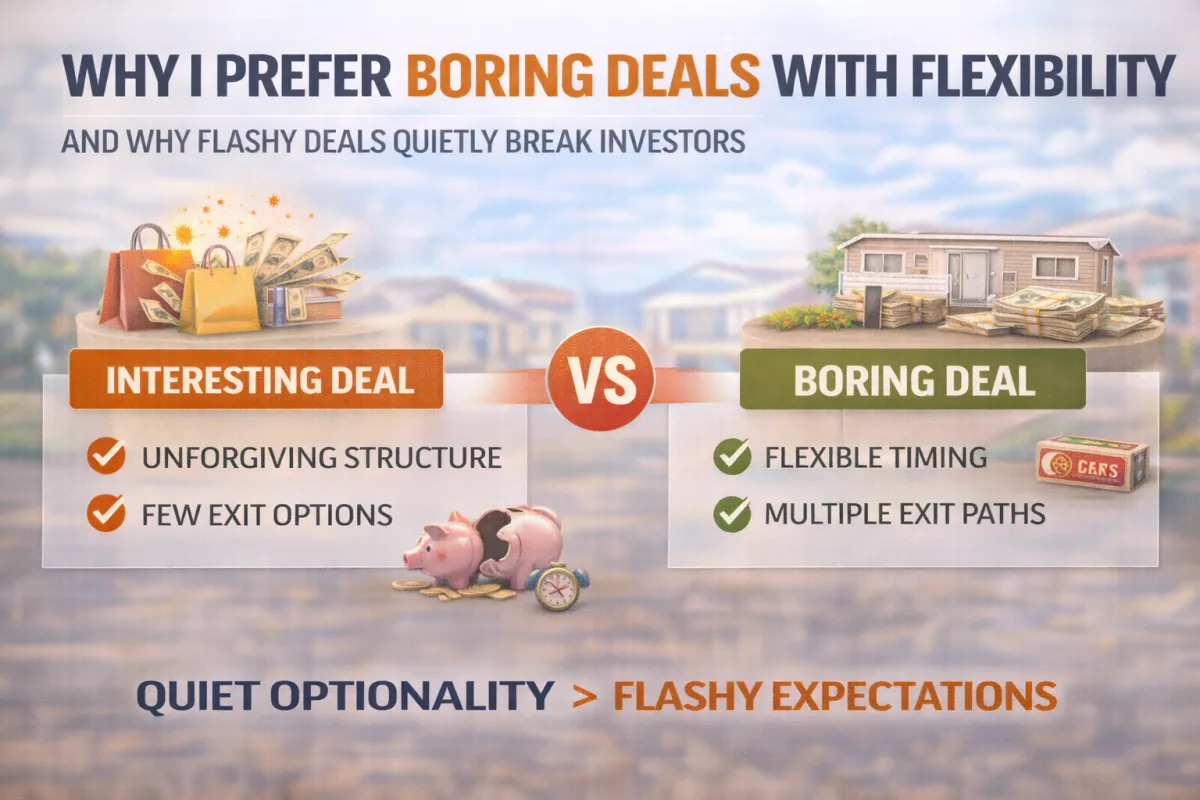
Why I Prefer Boring Deals With Flexibility
Why I Prefer Boring Deals With Flexibility
And Why Flashy Deals Quietly Break Investors
Some of the best deals I’ve ever done would never go viral on social media.
They aren’t:
New construction
Luxury finishes
Sexy markets
Big upside stories
They are:
Quiet
Unremarkable
Cash-flowing on Day 1
Structurally flexible
And that’s exactly why they work.
In investing, flexibility compounds better than flash.
Let me show you what I mean using a real deal I underwrote and moved forward with.
The Problem With “Interesting” Deals
Most investors are trained—intentionally or not—to chase excitement.
Deals that sound like:
“Huge upside after renovation”
“This one refi changes everything”
“Once stabilized, it explodes”
The issue isn’t that those deals can’t work.
It’s that they usually:
Require perfect execution
Depend on future market cooperation
Leave no margin for error
Flashy deals consume attention.
Boring deals preserve optionality.
The Case Study: A 5-Lot Mobile Home Park in Greenville, SC
One of the cleanest, most resilient deals in my current pipeline is also one of the least interesting on paper.
Asset:
5-lot mobile home park
Tenant-owned homes (TOH)
Sewer connected
100% occupied
No renovation story.
No expansion narrative.
No hype.
Just math.
The Numbers (Simplified)
Purchase Price: ~$300,000
Gross Rent: ~$4,325/month
NOI: ~$39,900/year
Senior Loan: ~70% LTV @ 10.75%
Seller Carry: 20% @ 0% interest, deferred payments
Buyer Equity: ~10%
Even at double-digit interest rates, the deal:
Cash flows ~$1,300+/month
Clears DSCR comfortably
Requires zero rent increases to survive
That’s boring.
And that’s exactly the point.
Where Flexibility Shows Up
This deal works because it has multiple exits and no forced moves.
If rates stay high:
It still cash flows
If rents never increase:
It still works
If refinancing takes longer:
No balloon pressure
If I want to sell:
Small TOH parks are liquid
Nothing in the deal demands a future event to justify the entry.
That’s flexibility.
Compare That to “Better” Deals
I’ve reviewed deals that looked far more impressive:
100+ units
Double-digit cap rates
Value-add upside
Paid-at-closing structures
But under stress, they had:
Thin cash flow
Tight DSCR
Deferred seller payments propping them up
Balloons arriving with no margin
Those deals weren’t risky because they were aggressive.
They were risky because they had no flexibility once things changed.
Flash Creates Fragility
Here’s the uncomfortable truth:
Flashy deals often remove flexibility.
They:
Over-leverage early
Lock you into refi timelines
Force operational perfection
Assume capital markets cooperation
Boring deals do the opposite.
They let you:
Wait
Adjust
Hold
Exit on your terms
This Is How I Filter Deals Now
I don’t ask:
“How big can this get?”
I ask:
“How badly can this go—and still survive?”
If the answer is “not very,” I pass.
That’s not conservative.
That’s disciplined.
Where This Shows Up in My Deal Structuring Work
When I help clients structure deals, this is one of the first principles we apply.
We engineer for:
Time instead of speed
Margin instead of max leverage
Optionality instead of hype
That’s why structure beats story every time.
If you want to see:
The types of deals I focus on → my Buy Box
How I evaluate, structure, and say no → How I Work
Or engage me directly on a deal → Deal Structure Services
I’m not trying to make deals look exciting.
I’m trying to make them survivable.
Final Thought
Some of the best investments in your portfolio won’t impress anyone at a dinner party.
They will:
Keep paying
Keep options open
Let you sleep
And over time, they’ll quietly outperform the flashy ones that needed everything to go right.
Flexibility compounds better than flash.
