
Occupancy Lies — Economic Occupancy Tells the Truth
Occupancy Lies — Economic Occupancy Tells the Truth
One of the most dangerous phrases in real estate underwriting is:
“It’s 90% occupied.”
That statement sounds comforting.
It feels safe.
It feels like demand is proven.
But physical occupancy does not pay the bills.
Economic occupancy does.
I’ve walked away from multiple deals that looked “full” on paper but were quietly bleeding cash once you looked under the hood. This article breaks down why high occupancy can be misleading, how to spot the warning signs early, and how one real portfolio nearly fooled buyers who didn’t dig deeper.
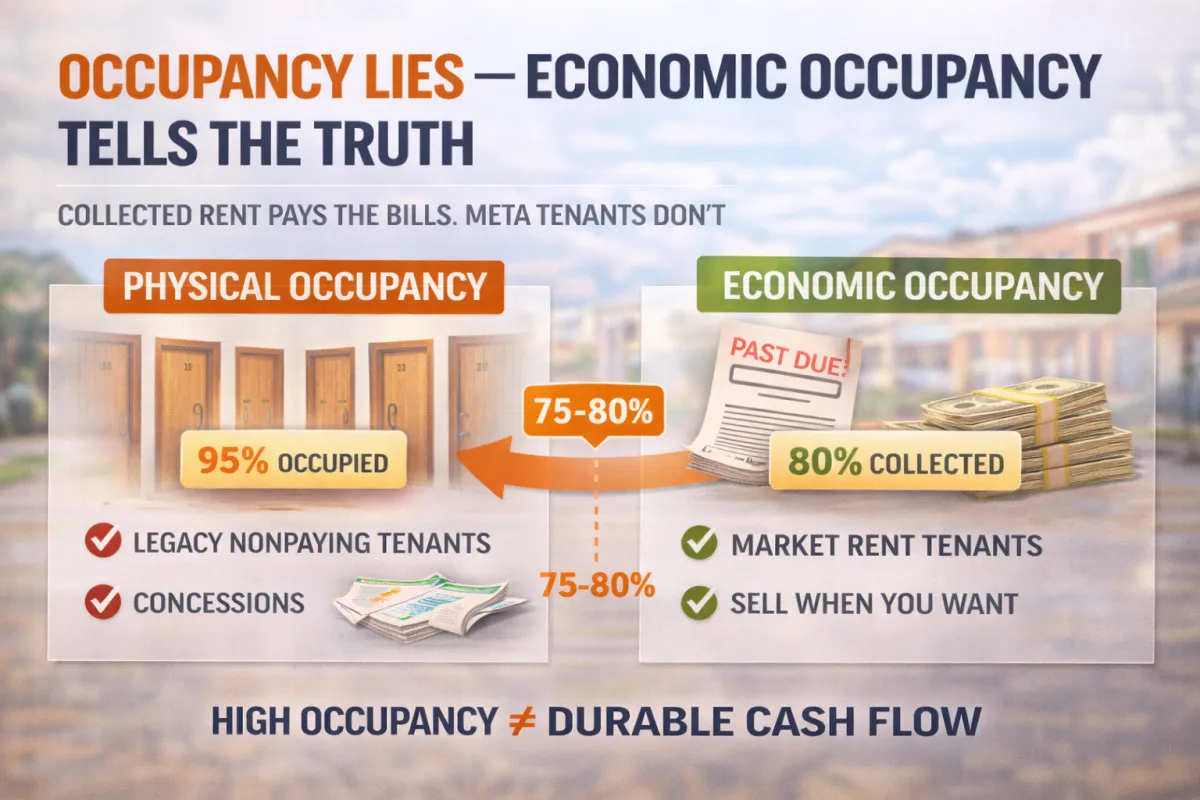
Physical Occupancy vs. Economic Occupancy (Quick Definition)
Physical occupancy = units that are filled
Economic occupancy = rent actually collected at market-supported levels
You can have:
95% physical occupancy
75–80% economic occupancy
And that gap is where deals break.
The Real Deal: Summer Park Portfolio — Killeen, TX (95 Units)
This was a 95-unit workforce housing portfolio spread across three nearby properties in Killeen, Texas.
At first glance, it looked solid.
What the Broker Marketed
~90%+ occupancy
“Stabilized” multifamily portfolio
Value-add upside
Seller financing available
Recent CapEx spend
To many buyers, that checks all the boxes.
But here’s what actually mattered.
What the Occupancy Didn’t Tell You
1. Legacy Tenants Were Masking Income Risk
A meaningful portion of tenants were:
Long-term occupants
Paying far below market
Protected only by inertia, not affordability
The moment rents were pushed:
Churn risk spiked
Vacancy risk jumped
Collections became uncertain
High occupancy ≠ durable occupancy.
2. Economic Occupancy Was Lower Than It Looked
The rent roll showed:
Units occupied
Rent billed
But the effective income told a different story once normalized.
Between:
Concessions
Late or partial payments
Non-paying legacy tenants
True economic occupancy was materially lower than the physical number suggested.
This matters because:
Lenders underwrite income
Refis require collections
Cash flow requires actual dollars
3. One-Month Accounting Distorted Reality
The T-12 financials included:
Property taxes booked in a single month
Insurance booked in a single month
That made NOI appear:
Stronger in most months
“Volatile but acceptable” on average
Once normalized, the expense load was much heavier than implied.
This is a classic way deals look better than they are.
Why This Matters More in Today’s Market
In a low-rate environment, sloppy economic occupancy could be masked.
Not anymore.
Today:
Debt coverage is tighter
Refi standards are stricter
Insurance and taxes are rising
Tenant quality matters more than unit count
A deal that relies on:
Legacy tenants
Under-market rents
Deferred collections
Is not stabilized — it’s fragile.
The Underwriting Rule I Use Now
I don’t ask:
“How occupied is it?”
I ask:
What % of rents are at market?
How many tenants survive rent resets?
What happens to NOI before renovations?
What does income look like after taxes and insurance normalize?
If the deal only works once rents are fixed, collections improve, and execution is perfect — it doesn’t work.
Occupancy Is a Story. Economic Occupancy Is a System.
Deals fail when investors confuse:
Full buildings with healthy income
Stability with stagnation
Low churn with low risk
Economic occupancy tells you:
Whether the asset can survive stress
Whether debt is actually supported
Whether your exit assumptions are real
Why I Passed on This Deal
The Summer Park portfolio wasn’t “bad.”
It was just:
Overstated on stability
Underestimated on repositioning risk
Priced like a light value-add
Structured like a heavy turnaround
That mismatch is where capital gets trapped.
Final Thought
High occupancy can lie.
Economic occupancy doesn’t.
If you’re not underwriting who pays, how much they pay, and how fragile that income is, you’re guessing — not investing.
Want Help Stress-Testing Economic Occupancy?
This is exactly the kind of analysis I do for clients before they submit offers or lock up capital.
If you want:
A real underwriting teardown
Capital stack stress-testing
Exit and refi realism checks
You can see how I work here:
👉 https://chadchoquette.com/how-i-work
Or explore my deal structure services here:
👉 https://chadchoquette.com/deal-structure-services
Most deals don’t fail because they were empty.
They fail because the income wasn’t real.
If you want a second set of eyes before that happens — reach out.
