
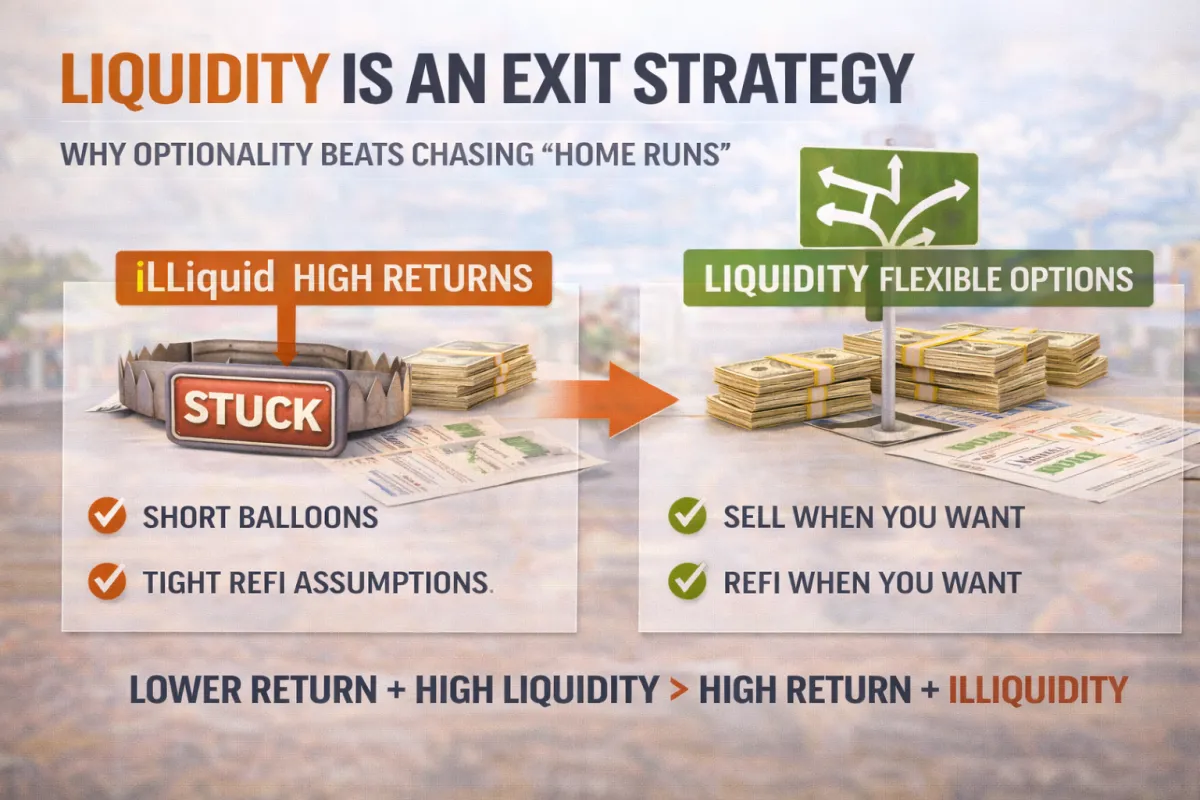
Liquidity Is an Exit Strategy
Liquidity Is an Exit Strategy
Why Optionality Beats Chasing “Home Runs”
Most investors talk about exits as if they’re events.
A refinance.
A sale.
A big payday.
But in real life, exits are rarely clean moments. They’re paths—and the quality of that path matters more than the headline return.
One of the most dangerous mistakes I see is investors confusing high projected returns with low risk, while completely ignoring liquidity.
In practice, deals that trap capital are often far riskier than deals with lower—but flexible—returns.
Liquidity isn’t boring.
Liquidity is survival.
The Hidden Risk No One Models: Being Stuck
A deal can look phenomenal on paper and still be fragile if it lacks liquidity.
Illiquidity shows up when:
Refinance assumptions are tight or speculative
Capital stacks rely on short balloons
There’s no viable partial exit or entity sale option
Cash flow is thin, forcing dependence on perfect execution
When any one of those breaks, the investor isn’t just underperforming—they’re trapped.
That’s when “home run” deals quietly turn into slow-motion disasters.
Real Deal Case Study: FM 1102 Retail Portfolio (Texas)
Let’s look at a real example.
Asset: Two-building retail portfolio
Purchase Price: ~$2.2M
Structure: DSCR loan + seller financing
NOI: ~$139K
DSCR: ~1.08x
On the surface, this deal worked.
It technically cash flowed.
The lender approved it.
The seller deferred payments for five years.
But here’s the key issue:
Liquidity was tight.
Why This Deal Was Fragile
DSCR was barely above lender minimums
Seller payments were deferred, not forgiven
A balloon loomed at Year 5
Cash flow margin left no room for tenant loss
Refinance depended on rent growth actually materializing
This wasn’t a bad deal—but it was a liquidity-sensitive deal.
If the refinance window closed, or NOI didn’t grow fast enough, options narrowed quickly.
The math didn’t fail.
The flexibility was the risk.
Liquidity Creates Time—and Time Creates Safety
Here’s what liquidity actually gives you:
The ability to refinance when it’s optimal, not when you’re forced
The option to sell the entity instead of the asset
The ability to recapitalize instead of fire-selling
Negotiating leverage when lenders tighten
The freedom to wait out volatility
In the FM 1102 deal, liquidity planning meant:
Modeling refi scenarios early
Stress-testing NOI against lender DSCR thresholds
Understanding what happens if rents lag
Treating seller financing as temporary support—not permanent capacity
That planning didn’t guarantee success.
It prevented surprise failure.
Why Illiquid “Home Runs” Are So Dangerous
I see this pattern constantly:
Aggressive leverage
Thin cash flow
Heavy seller carry
Short balloons
“We’ll just refi” as the exit
These deals often show incredible IRRs.
Until:
Rates stay high longer than expected
Appraisals come in light
Insurance resets
Lenders change DSCR standards
Then the deal isn’t just underperforming—it’s cornered.
Illiquidity doesn’t announce itself.
It shows up when you need options and don’t have any.
How I Evaluate Liquidity Before I Ever Fall in Love With a Deal
Before I pursue a deal seriously, I want answers to questions like:
Can this refinance today, not just later?
What happens if NOI is flat for 24 months?
Is there an entity sale path if debt markets tighten?
Can this deal survive without perfect execution?
Who would buy this asset if I needed to exit early?
If those answers are weak, I don’t “get creative.”
I walk.
Liquidity Is Why Structure Matters More Than Price
This is where deal structuring becomes the difference between control and exposure.
Creative finance is powerful only when it increases optionality:
Longer balloons
Extension rights
Seller paper that buys time without masking risk
Capital stacks that can flex instead of snap
That’s the work I do with clients—engineering structures that don’t just close deals, but preserve exits.
If you want a deal reviewed, restructured, or stress-tested around liquidity—not hype—you can see how I work here:
👉 https://chadchoquette.com/how-i-work
And if you want help engineering capital stacks that protect flexibility and exits, my deal structuring services are here:
👉 https://chadchoquette.com/deal-structure-services
Final Thought
Returns matter.
But liquidity determines whether you live long enough to realize them.
I’ll take a deal with:
Multiple exit paths
Conservative leverage
Real optionality
Over an illiquid “home run” every time.
Because capital you can’t move is capital that eventually moves against you.
