
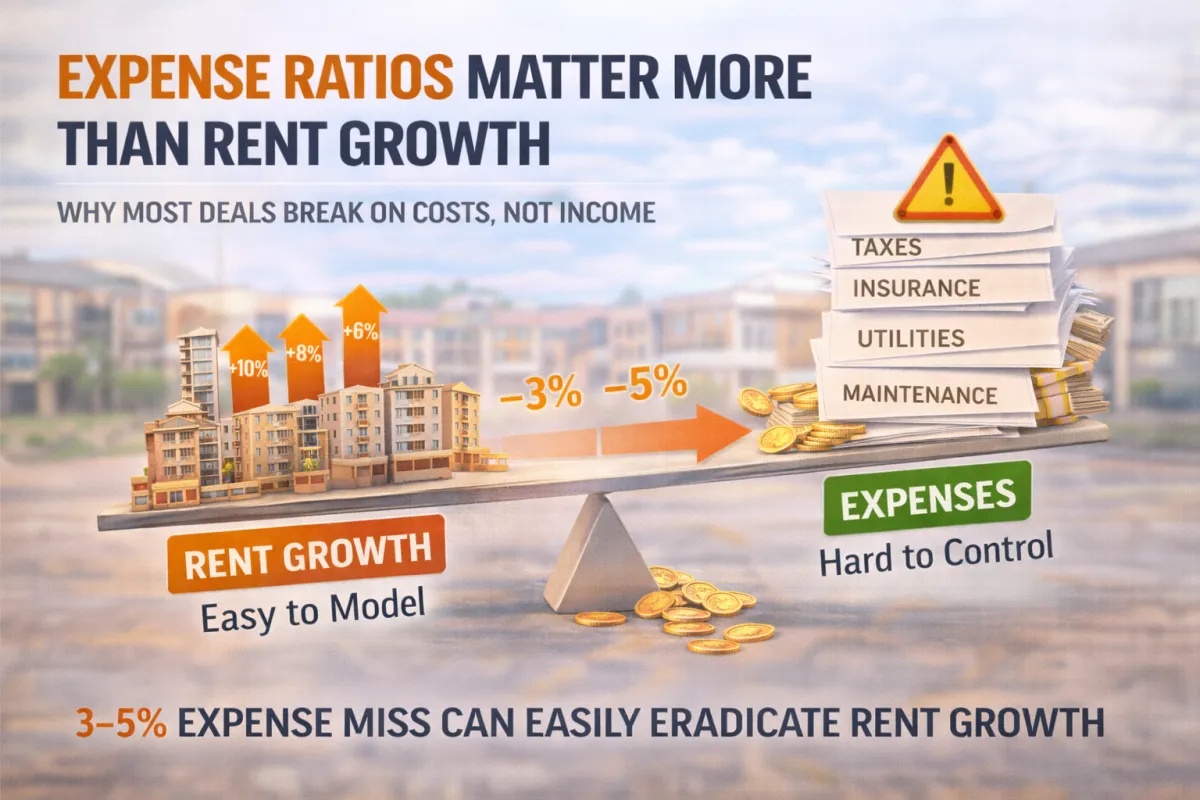
Expense Ratios Matter More Than Rent Growth
Expense Ratios Matter More Than Rent Growth
Why Most Deals Break on Costs, Not Income
Raising rents is easy to model.
Controlling expenses is not.
And in real underwriting, expense ratios matter more than rent growth—because every percentage point you miss compounds forever.
I see this mistake constantly, especially in value-add multifamily and “workforce” portfolios:
Aggressive rent growth assumptions
Flat or shrinking expense ratios
Pro formas that only work if nothing goes wrong
Then reality shows up.
Not as a rent problem—but as a cost problem.
Let me walk you through a real deal where this distinction changed the entire decision.
The Deal That Looked Fine—Until Expenses Told the Truth
I recently underwrote a 95-unit multifamily portfolio in Killeen, TX (three properties within blocks of each other).
At first glance, the deal looked serviceable:
~90%+ reported occupancy
~$725K annualized gross income (broker-adjusted)
“Light value-add” narrative
Recent CapEx already spent
On paper, the upside story was rent growth.
But the real risk wasn’t rent.
It was expenses.
Where the Pro Forma Broke
Here’s what surfaced once we stripped the story down to reality:
1. Taxes Were Understated
Property taxes were running ~$165K/year across the portfolio—and likely to reset higher post-sale.
That alone invalidated the broker’s forward NOI assumptions.
2. Insurance Was Rising, Not Flat
Texas multifamily insurance isn’t stabilizing—it’s escalating.
The trailing insurance cost was already ~$62K/year, with real exposure to future increases.
3. CapEx Was Being Disguised as “Past Spend”
Yes, ~$135K+ had been spent in the last 12 months.
No, that did not mean the asset was stabilized.
Remaining value-add CapEx was still conservatively $7K–$10K per unit, or $630K–$900K portfolio-wide.
4. Expense Timing Was Distorted
One-month booking of taxes and insurance artificially inflated T-12 NOI.
That’s not fraud—but it is misleading if you don’t normalize it.
The Real Math: Expense Ratios vs Rent Growth
Let’s be clear about something most investors underestimate:
Every 1% miss in expense ratio compounds forever.
Rent growth happens in steps.
Expense creep is permanent.
In this deal:
A 3–5% expense miss erased the entire projected rent upside
NOI durability collapsed under conservative stress testing
DSCR margin disappeared without any dramatic vacancy event
The deal didn’t fail because rents were wrong.
It failed because the expense structure wasn’t durable.
Why Rent Growth Is the Weakest Lever
Rent growth depends on:
Tenant tolerance
Market momentum
Economic stability
Political risk
Time
Expense control depends on:
Asset quality
Utility structure
Insurance exposure
Tax basis
Operational discipline
Only one of those is truly controllable.
That’s why experienced operators focus on expense resilience, not just rent upside.
What I Look for Instead
Before I care about rent growth, I want to know:
What happens if expenses run 5–10% higher than modeled?
Does the deal still survive at today’s rates?
Is NOI durable before value-add?
Can this asset absorb tax and insurance resets without forcing a refi?
If the answer is no, rent growth won’t save it.
This Is Where Deal Structure Actually Matters
This is also why structure beats story.
A deal with:
Lower leverage
Seller financing
Longer balloons
Real DSCR margin
Can survive imperfect execution.
A deal that relies on rent growth to offset weak expense assumptions cannot.
This is the difference between engineering safety and hoping for upside.
The Real Takeaway
Most deals don’t fail because income was overstated.
They fail because expenses were understated.
Rent growth makes spreadsheets look good.
Expense discipline keeps deals alive.
Want Help Stress-Testing Your Expense Assumptions?
If you’re underwriting deals that:
Only work at 35–40% expense ratios
Assume flat insurance or taxes
Require rent growth to survive debt
That’s exactly where I step in.
I work with investors to:
Rebuild capital stacks around real NOI
Stress-test expenses, not just income
Engineer downside protection before offers are written
You can see how I work here:
👉 https://chadchoquette.com/how-i-work
And if you want help structuring or salvaging a deal before it traps capital:
👉 https://chadchoquette.com/deal-structure-services
If you want to know whether a deal is strong—or just optimistic—expenses will tell you the truth every time.
