
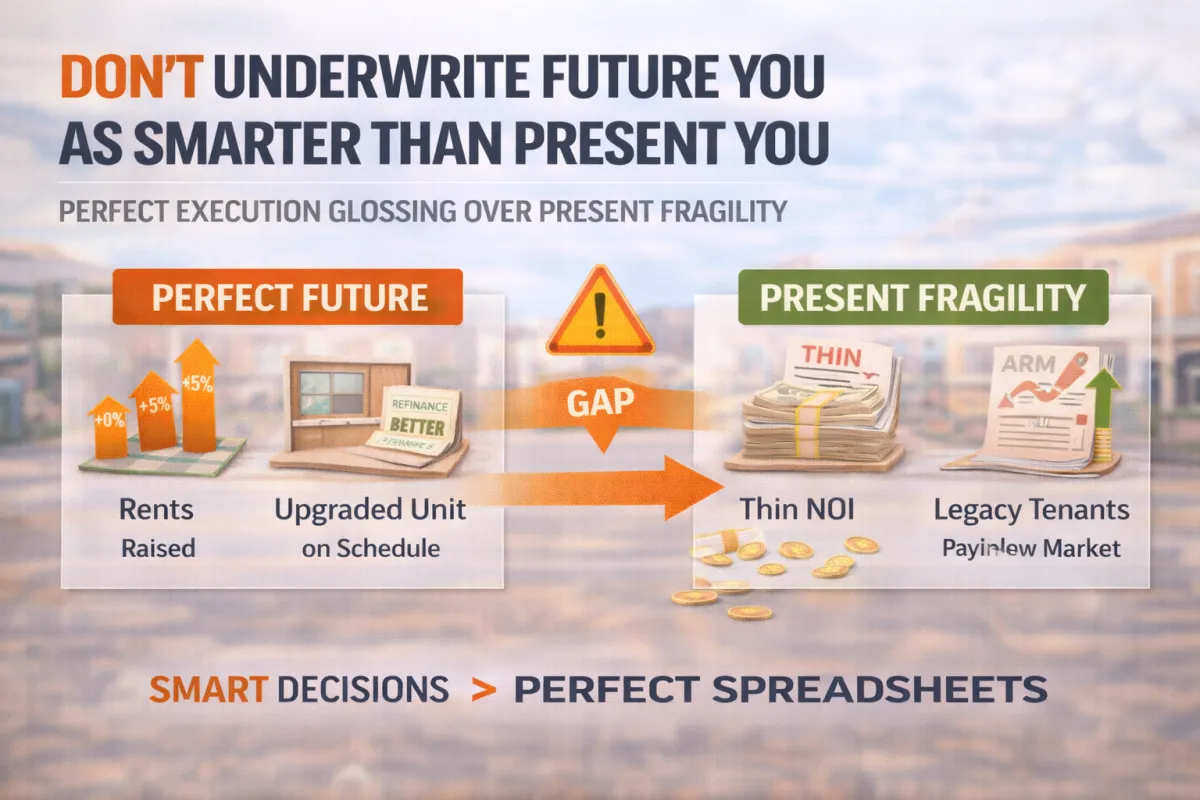
Don’t Underwrite Future You as Smarter Than Present You
Don’t Underwrite Future You as Smarter Than Present You
Why deals that require “perfect execution” are quietly dangerous
One of the most common underwriting mistakes I see—especially among capable, motivated investors—is this:
They assume future them will be smarter, faster, more disciplined, and luckier than present them.
The spreadsheet works…
But only after everything goes right.
All rents get raised
Every unit gets renovated on schedule
Expenses normalize immediately
Refinance terms improve
No surprises show up along the way
That’s not underwriting.
That’s optimism.
And optimism is not a risk-management strategy.
The Trap: Betting on Perfect Execution
Here’s how this usually shows up in deal reviews:
“It’s tight now, but once we fix X, Y, and Z, it’s a great deal.”
That sentence alone is a warning sign.
Because real deals don’t fail due to one big mistake.
They fail due to stacked assumptions.
If your deal only works after:
Full rent optimization
Immediate expense control
Smooth renovations
A cooperative refinance market
You’re not underwriting the asset.
You’re underwriting your best-case future self.
And markets don’t care how confident you are.
Real Case Study: Summer Park Portfolio – 95 Units (Killeen, TX)
Let’s ground this in a real deal I reviewed: the Summer Park 95-unit portfolio in Killeen, Texas.
On paper, it looked serviceable.
The Story Being Sold
~90%+ occupancy
“Light value-add”
Recent CapEx already spent
Modest rent upside remaining
The pitch was simple:
“Clean it up a bit, push rents, stabilize, refi.”
But when I stripped the story down to reality, the cracks were obvious.
Where the Underwriting Broke
1. In-Place NOI Was Already Thin
The T-12 NOI was distorted by accounting quirks:
Taxes and insurance booked in a single month
Recent CapEx treated as “done,” not ongoing
Legacy tenants under market rents
Once normalized, the in-place NOI barely supported debt.
That means there was no margin for error.
2. Value-Add Was Assumed, Not Earned
Remaining CapEx was materially understated:
~$7K–$10K per unit still needed
Tenant churn risk ignored
Rent resets assumed to be frictionless
This wasn’t light value-add.
It was a multi-year tenant-base rebuild.
3. Rate and Refi Risk Were Hand-Waved
The entire deal logic depended on:
Stable or improving rates
A cooperative refinance market
NOI growth happening on schedule
But if rates stayed flat—or worse, moved up—there was no safety net.
That’s not conservative underwriting.
That’s hope with a spreadsheet.
The Core Problem: Present NOI Didn’t Protect the Deal
Here’s the key insight:
If the deal doesn’t work before the improvements,
the improvements don’t make it safe—they make it fragile.
Future execution should improve returns, not rescue feasibility.
In this case:
The deal only worked once everything went right
Any delay, cost overrun, or rate shock broke the model
There was no durable cash flow to absorb mistakes
So I passed.
Not because upside didn’t exist—but because downside wasn’t survivable.
A Better Underwriting Question
Instead of asking:
“How good does this get if we execute perfectly?”
Ask this:
“Does this survive if we’re late, wrong, or unlucky?”
Because real life will test all three.
Good deals tolerate mistakes.
Great deals expect them.
How I Approach Deals Differently
When I structure or review deals, I underwrite to present reality first, not future heroics.
That means:
Stress-testing in-place NOI
Assuming slower execution
Modeling higher expenses
Treating refis as optional—not guaranteed
Future upside should be bonus, not life support.
This discipline is baked into how I work with clients and partners, whether that’s:
Rebuilding capital stacks
Stress-testing seller financing
Engineering exits that don’t depend on perfect timing
If you want to see how I evaluate deals before structure even comes into play, my buy box and underwriting philosophy are outlined here:
👉 https://chadchoquette.com/buy-box
Final Thought
If a deal only works once future you fixes everything…
You’re not underwriting the deal.
You’re underwriting a version of yourself that hasn’t been stress-tested yet.
Markets will test it for you.
Want Help Pressure-Testing a Deal Before You Commit?
If you’re sitting on a deal that:
“Almost” works
Depends on perfect execution
Feels tight but tempting
That’s exactly where disciplined structuring and sober underwriting matter most.
I work with investors to:
Rebuild capital stacks
Identify hidden refi and balloon risk
Decide whether to restructure—or walk away
You can see how I work here:
👉 https://chadchoquette.com/how-i-work
And explore my deal structure services here:
👉 https://chadchoquette.com/deal-structure-services
Sometimes the smartest move isn’t making a deal work.
It’s knowing when not to force one.
