
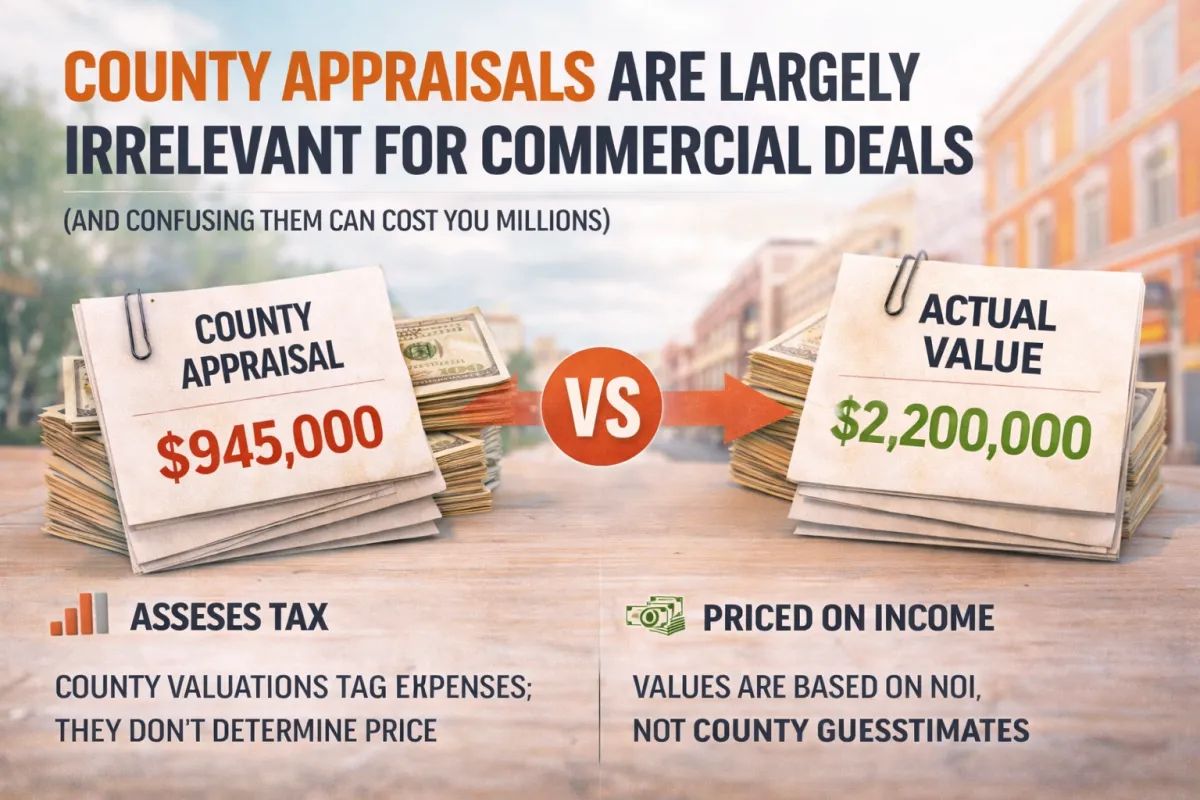
County Appraisals Are Largely Irrelevant for Commercial Deals
County Appraisals Are Largely Irrelevant for Commercial Deals
(And Confusing Them Can Cost You Millions)
One of the most common mistakes I see newer commercial investors make is treating county appraised value as a proxy for market value.
It isn’t.
In residential real estate, county values can sometimes loosely track market pricing.
In commercial real estate, they almost never do.
Commercial assets are not priced based on comparable sales or assessor opinions.
They are priced based on income.
And when you confuse those two valuation frameworks, you either:
Walk away from perfectly good deals, or
Think you’re getting a steal when you’re actually overpaying
Let’s break this down using a real deal I underwrote.
The Core Misunderstanding
County appraisals exist for one reason:
To assess taxes — not to determine market value.
County assessors:
Revalue infrequently
Use mass-appraisal models
Often lag real income changes by years
Do not underwrite NOI, DSCR, or debt capacity
Commercial buyers, lenders, and sophisticated investors care about exactly one thing:
How much income does the asset reliably produce?
Everything else is secondary.
Real Deal Case Study: Texas Retail Portfolio (FM 1102)
I recently underwrote a two-building retail portfolio in Texas structured with a Morby-style seller finance + DSCR stack.
Here’s where most investors would have panicked.
The County Numbers
Combined county appraised value: ~$945,000
Contract purchase price: $2,200,000
At a glance, that looks insane.
More than 2× the county value.
If you’re using county data as your truth source, you’d immediately assume:
The seller is delusional
The deal is overpriced
Something fraudulent is happening
None of that was true.
The Income Reality
Here’s what actually mattered:
Trailing 12-month NOI: $139,477
Purchase price: $2.2M
Implied cap rate: ~6.3%
Market cap for stabilized retail in the area: ~6%–6.75%
From an income perspective, the price was fully supported.
The county valuation simply hadn’t caught up — and never needed to.
Commercial lenders don’t care what the county says.
They care whether:
NOI supports debt service
DSCR meets thresholds
Income is durable
Tenants are real and paying
Why the Gap Exists (And Why It’s Normal)
County values are often dramatically lower than true market value for commercial assets because:
Counties don’t mark-to-market annually
Income increases don’t immediately re-assess
Many assessors still rely on cost or outdated sales models
Counties err on the side of conservatism to avoid appeals
In fact, large gaps between county value and purchase price are extremely common in:
Retail
Industrial
Mixed-use
Mobile home parks
Hospitality
That gap alone tells you nothing about deal quality.
Where Investors Get Hurt
The danger isn’t ignoring county value.
The danger is misusing it.
I see investors make two fatal mistakes:
Mistake #1: Walking Away from Good Deals
They say:
“I’m not paying double the county value.”
And they pass on assets with:
Strong NOI
Solid tenants
Real debt coverage
Mistake #2: Ignoring County Value Completely
County values still matter for:
Tax reassessment risk
Future operating expense increases
Post-acquisition cash flow modeling
County value doesn’t determine price —
but it does influence future taxes.
Ignoring that is just as dangerous.
The Right Mental Model
Here’s the framework I use:
Income determines value
County appraisals influence expenses
Debt capacity determines survivability
Structure determines risk
You don’t compare county value to price.
You compare:
NOI → price
NOI → debt service
NOI → refinance viability
Everything else is noise.
Why This Matters for Creative & Structured Deals
This distinction becomes even more important when you’re using:
Seller financing
DSCR loans
Deferred payments
Morby-style capital stacks
In the FM 1102 deal:
County value was irrelevant to pricing
Income supported the deal
Refinance risk, not county value, was the real concern
That’s where inexperienced investors get distracted by the wrong variable — and miss the actual risk.
Final Thought
County appraisals are not wrong.
They’re just answering a different question.
If you treat tax assessments like market value in commercial real estate, you’ll consistently misprice risk — and misjudge opportunity.
How I Help Investors Avoid This Mistake
A big part of my deal-structure work is helping investors:
Separate signal from noise
Underwrite income correctly
Model tax resets realistically
Engineer capital stacks that survive reality — not spreadsheets
If you’re evaluating a deal where:
The price feels “high” relative to county value
The income story is strong but confusing
The structure matters more than comps
That’s exactly the type of deal I help analyze and structure.
You can see how I work here:
👉 https://chadchoquette.com/how-i-work
Or explore deal structure support directly here:
👉 https://chadchoquette.com/deal-structure-services
