
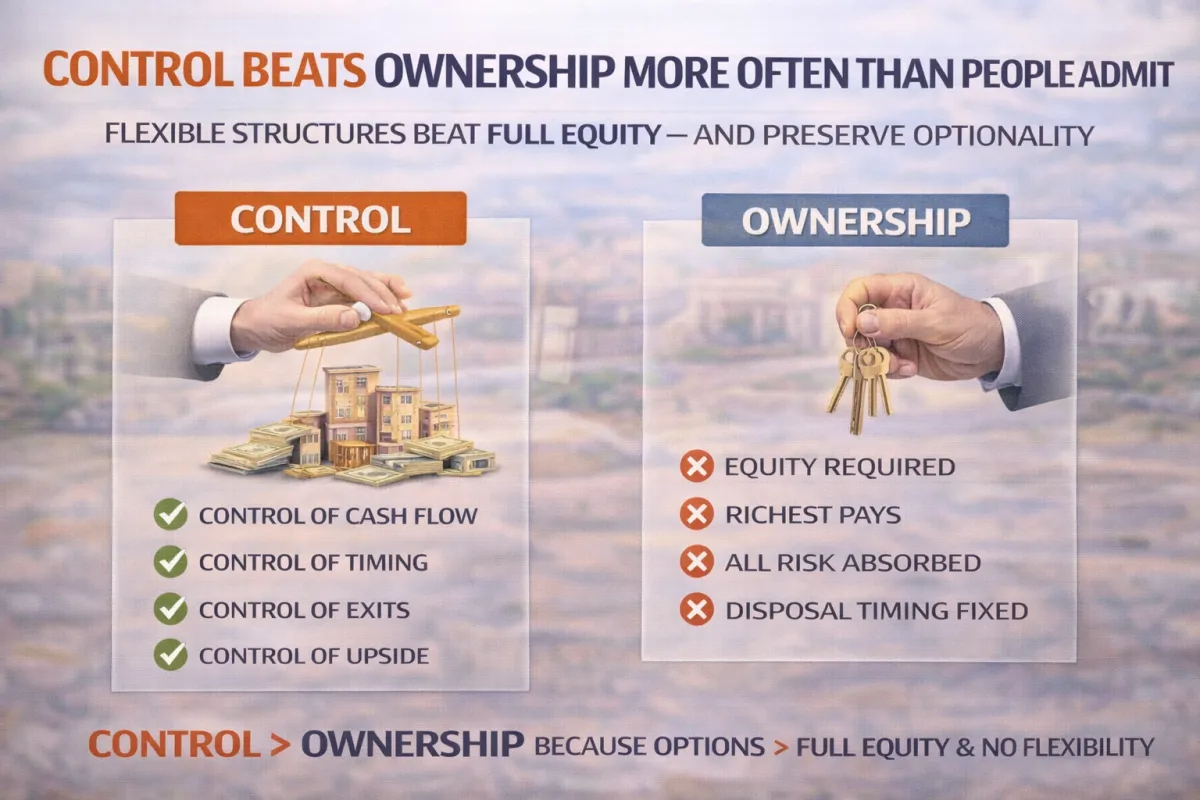
Control Beats Ownership More Often Than People Admit
Control Beats Ownership More Often Than People Admit
Most investors are taught the same rule early:
“Own the asset.”
But in practice, many of the most profitable — and safest — deals don’t start with full ownership at all. They start with control.
Control determines:
Who captures upside
Who dictates timing
Who engineers exits
Who absorbs risk
Ownership is just one way to get control — and often the most expensive one.
Ownership Is a Legal Concept. Control Is an Economic One.
Ownership answers:
Who’s on title?
Who holds equity?
Control answers:
Who decides rents?
Who controls cash flow?
Who chooses when and how to exit?
Who benefits from appreciation and NOI growth?
In volatile markets, control structures outperform ownership structures because they preserve flexibility.
I’ve structured multiple deals where:
Ownership was partial or delayed
Control was immediate
Upside belonged to the operator
Risk stayed capped
Let’s walk through a real example.
Case Study: FM 1102 Retail Portfolio (New Braunfels, TX)
This was a small commercial retail portfolio underwritten as a tight DSCR deal that only worked with structure — not price.
The Basics
Purchase Price: ~$2.2M
Trailing NOI: ~$139K
DSCR Loan: ~70% LTV
Seller Financing: $1.32M
Seller Payments: $0/month for 5 years
Buyer Paid at Closing: ~$275K
On paper, ownership looked risky:
Thin DSCR (~1.08x)
County appraisal far below purchase price
Balloon risk in year 5
But ownership wasn’t the strategy.
Control was.
What Control Looked Like in This Deal
Instead of focusing on equity percentage or long-term hold assumptions, the deal was structured around operational and timing control:
1. Control of Cash Flow
Seller payments were fully deferred.
That meant:
Day-one positive cash flow
No operational drag from stacked debt
Ability to absorb vacancy or repairs
2. Control of Time
The seller note had:
A long balloon
Extension options
No amortization pressure
Time created optionality.
3. Control of Exit Paths
The deal supported multiple exits:
Refinance after NOI growth
Sale of the real estate
Entity sale to a buyer seeking depreciation and basis
Assignment-style monetization up front
Ownership wasn’t required to monetize the deal.
Control was.
Why Full Ownership Would Have Been Worse
If this deal had required:
Full equity at closing
Immediate seller payments
Tight amortization
No extension rights
…it would have failed.
Ownership would have:
Increased capital at risk
Reduced flexibility
Forced a refinance
Eliminated margin for error
Control allowed the deal to:
Work conservatively
Absorb stress
Survive imperfect execution
Control Structures You Should Understand
Control can be engineered through:
Seller financing with deferred payments
Master leases with options
Entity-level acquisitions
Management + profit participation structures
Partial equity with operational control
Option agreements with fixed pricing
Each shifts risk away from the operator and toward time and performance.
The Real Question You Should Ask
Instead of:
“How much do I own?”
Ask:
“What do I control?”
If you control:
Operations
Cash flow
Timing
Exit decisions
…ownership becomes secondary.
Where Investors Get This Wrong
Most investors overpay for ownership because they:
Confuse equity with safety
Fear non-traditional structures
Don’t understand exit engineering
Optimize for optics instead of durability
Control structures aren’t beginner strategies — but they are professional ones.
How This Ties Into My Deal Structuring Work
This is exactly how I work with clients:
I don’t start with price.
I start with control.
That means:
Engineering capital stacks that preserve flexibility
Designing exits before closing
Avoiding forced refinances
Structuring time as an asset
If you’re working on a deal that:
Barely works on paper
Requires perfect execution
Depends on a refinance
Feels fragile
…it may not need a better price.
It may need a better structure.
You can see how I approach this here:
👉 https://chadchoquette.com/how-i-work
Or review my deal structuring services directly:
👉 https://chadchoquette.com/deal-structure-services
If a deal fits my buy box and needs structural engineering instead of spreadsheet optimism, I can usually tell you quickly.
Final Thought
Ownership feels safe.
Control is safe.
The best investors don’t chase title —
they engineer leverage, time, and optionality.
That’s where real returns come from.
